English Test Lab • Guía de Práctica

1. Vocabulario y Plan de Estudio

5.º EGB • 9 años
Material Familiar
Plan de 3 sesiones sugeridas (15–20 min):
1) Palabras y comparativos. • 2) Planes futuros y lectura. • 3) Diario de 50 palabras y speaking oral.

Vocabulario del temario (10 términos)

Bigger: más grande.
The elephant is bigger than the cat.
Smaller: más pequeño.
The cat is smaller than the elephant.
Faster: más rápido.
A rabbit is faster than a snail.
Slower: más lento.
A snail is slower than a rabbit.
Taller: más alto (personas, árboles, edificios).
Ana is taller than Tom.
Shorter: más bajo o más corto.
Tom is shorter than Ana.
Glasses: gafas / lentes (accesorio).
He wears glasses.
Curly hair: cabello rizado (con rulos).
She has curly hair.
Wavy hair: cabello ondulado (ondas suaves).
He has wavy hair.
Blond hair: cabello rubio (o blonde).
She has blond hair.

Reglas gramaticales esenciales

• has + característica física: She has curly hair.
• is + adjetivo directo: She is tall. Tom is short.
• wears + prenda o accesorio: He wears glasses. She wears a shirt.
• Hair no lleva s: Hablamos de todo el cabello como sustantivo no contable: curly hair (nunca curly hairs).
Consejo de estudio: No memorices solamente. Tapa las frases en inglés e intenta decirlas mirando la traducción en español.
English Test Lab • Guía de Práctica

2. Comparatives — Comparar dos cosas

Estructura y Reglas
A + is + comp + than + B
Patrón fundamental: A + is + comparative + than + B.
Than significa «que» al comparar: The blue bag is bigger than the red bag.
¡Prohibido escribir!: more bigger, more better ni bigger that.

Reglas de formación de adjetivos comparativos

Modelos resueltos del temario

1. This box is (big) bigger than that box. (Se duplica la g).
2. The red bag costs $10. The blue bag costs $20. → The blue bag is more expensive than the red bag.
3. This book is better than that book. (Irregular de good).
4. This cold is worse than my last cold. (Irregular de bad).
Transferencia activa: Para practicar de verdad, inventa comparaciones con objetos de tu casa. No repitas siempre la misma frase memorizada.
English Test Lab • Guía de Práctica

3. Future Plans — Planes Futuros

Going to vs Present Continuous
Concordancia y Destino
Aclaración sobre el aviso del profesor:
El aviso titula este tema «GOING TO», pero sus tres frases de ejemplo están construidas en PRESENTE CONTINUO para planes futuros. Aprende a distinguir ambas formas para responder con seguridad según lo que pida el docente.

Estructura A: Be going to + verbo base (Intención / Plan)

Fórmula: Sujeto + am/is/are + going to + VERBO BASE.
• I am going to study tomorrow. (Yo voy a estudiar mañana).
• She is going to visit London next month. (Ella va a visitar Londres).
• They are going to buy a car. (Ellos van a comprar un auto).
• Pregunta: What are you going to do tomorrow?
• Negación: He is not going to buy a car.

Estructura B: Presente continuo para planes concertados

Fórmula: Sujeto + am/is/are + VERBO-ing + tiempo futuro.
• They are studying for the exam on Saturday.
• She is going to London next month.
• He is buying a new car next week.
• Pregunta: What is Rick doing next week? → He is buying a new car next week.

¡Atención a la diferencia de London!

En «She is going to London», London es un lugar de destino, no un verbo. El verbo es going en presente continuo.
Para que sea la estructura de going to + verbo, se necesita un verbo en forma base: «She is going to visit London».

Expresiones de tiempo futuro

English Test Lab • Guía de Práctica

4. Reading — Where Do Our Eyes Come From?

Lectura Original
Glosario y Comprensión
«Have you ever wondered why your eyes look the way they do? In science, the features you get from your family are called inherited traits. Your eye color, shape, and vision are traits passed down from your biological parents through tiny genetic instructions. When you were born, you received a mix of traits from both your mother and your father. That is why your eye color might match one parent, or why your eyes look like a blend of both! Even if you have brothers or sisters, you won't get the exact same mix of traits, which is why your eyes are uniquely yours.»

Glosario de apoyo en español

inherited traits: rasgos heredados
features: características
passed down: transmitidos / heredados
biological parents: padres biológicos
mix / blend: mezcla o combinación
match: coincidir o parecerse
uniquely yours: únicos y propios tuyos
both: ambos (padre y madre)
Cómo responder las preguntas: Localiza la palabra clave en el texto y cita la evidencia literal en una frase breve en inglés.

Preguntas de comprensión lectora (Práctica escrita)

26. What are inherited traits?
27. Name TWO eye traits mentioned in the passage.
28. Who passes these traits down to a child?
29. What carries the instructions for these traits, according to the passage?
English Test Lab • Guía de Práctica

5. Writing — A 50-word journal entry

Tiempo Pasado • 50 palabras
Modelo y Pauta de Escritura
Consigna: Escribe una entrada de diario de 50 palabras exactas sobre un acontecimiento especial que te haya ocurrido. Es sobre el PASADO (no uses planes futuros).

Modelo sugerido de EXACTAMENTE 50 palabras

«Last Saturday, I went to the park with my family. We played football and had a picnic under a big tree. My brother brought a red ball. I ate a cheese sandwich and drank water. We laughed a lot. I felt very happy because we spent a wonderful day together.»

Verbos útiles en pasado y plantilla guiada

Tu borrador pautado (escribe tu propio relato)

Lista de revisión: [ ] Evento pasado especial • [ ] Verbos en pasado • [ ] Mayúsculas y puntos • [ ] 50 palabras contadas por espacios • [ ] Sentimientos claros.
English Test Lab • Guía de Práctica

6. Speaking — Describe the picture
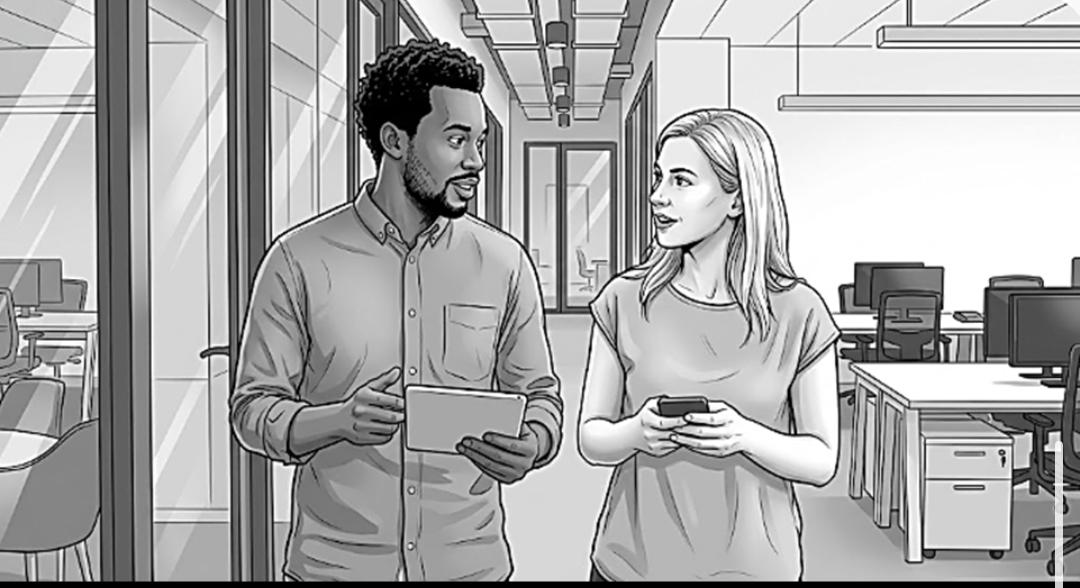
Fotografía Observable del Aviso
Guía de 5 minutos
Fotografía en escala de grises de una oficina
Hechos observables (no inventar colores):
• Lugar: In an office (desks, computers, chairs, lights).
• Hombre: Short, curly, dark hair and a beard; wearing a shirt; holding a tablet.
• Mujer: Long, straight hair; wearing a T-shirt; holding a smartphone.
• Acción: Looking at each other.

Modelo breve sugerido para practicar

«In this picture, I can see a man and a woman. They are in an office. The man has short, curly hair and a beard. He is wearing a shirt. The woman has long, straight hair. She is wearing a T-shirt. He is holding a tablet, and she is holding a smartphone. There are desks, chairs and computers behind them. They are looking at each other. I think they are talking about work. The office looks bright and clean.»

Guía oral para conversar en 5 minutos con un adulto

Nota pedagógica: No se exige un monólogo corrido de 5 minutos. El objetivo es responder preguntas y describir con calma.
English Test Lab • Guía de Práctica

7. Práctica Parte 1: Ejercicios 1 al 18

Vocabulario y Comparativos
Responde antes de mirar la clave

A. Vocabulary (Ejercicios 1 al 8)

1. Comparing SIZE: An elephant is ___ than a cat. (bigger / smaller / shorter) →
2. A snail is ___ than a rabbit. (faster / slower / taller) →
3. Leo is 140 cm tall. Max is 130 cm tall. Leo is ___ than Max. (shorter / smaller / taller) →
4. Max is ___ than Leo. (shorter / faster / bigger) →
5. What does «glasses» mean? (guantes / gafas / zapatos) →
6. Hair with curls is ___. (wavy hair / blond hair / curly hair) →
7. Hair with soft waves is ___. (wavy hair / curly hair / short hair) →
8. What does «blond hair» mean? (cabello oscuro / cabello rubio / cabello rizado) →

B. Comparatives (Ejercicios 9 al 18) — Escribe solo el comparativo

9. This box is (big) ___ than that box. →
10. This kitten is (cute) ___ than that toy kitten. →
11. My bag weighs 4 kg. Your bag weighs 2 kg. My bag is (heavy) ___ than yours. →
12. This pencil is (short) ___ than that pencil. →
13. This plan is (good) ___ than the old plan. →
14. This result is (bad) ___ than my last result. →
15. This story is (interesting) ___ than that story. →
16. For staying healthy, drinking water is (important) ___ than choosing a phone wallpaper. →
17. Bag A costs $20. Bag B costs $10. Bag A is (expensive) ___ than Bag B. →
18. I think this garden is (beautiful) ___ than that garden. →
English Test Lab • Guía de Práctica

8. Práctica Parte 2: Ejercicios 19 al 36

Futuro • Lectura • Corrección
Responde con atención

C. Future plans (19 al 25) — Ordena todas las fichas

19. studying / exam / the / They / for / are →
20. London / going / is / She / to →
21. car / buying / He / new / is / a →
22. tomorrow / going / I / study / am / to →
23. next / are / football / We / playing / week →
24. She ___ going to visit London. (am / is / are) →
25. Which uses going to + BASE VERB? (She is going to London. / She is going to visit London. / She is in London.) →

D. Reading questions (30 al 32) — Basadas en la lectura escolar

30. Do children receive traits from only one parent or from both parents? →
31. According to the passage, do brothers and sisters always get the exact same mix? →
32. Why can brothers and sisters have different-looking eyes, according to the passage? →

E. Spot and fix the mistake (33 al 36) — Corrige el error

33. This bag is more bigger than that bag. →
34. She has curly hairs. (hablando de todo su cabello) →
35. He are buying a new car next week. →
36. I am going to studying tomorrow. →
English Test Lab • Guía de Práctica

9. Transferencia (37 al 40) y Guía Familiar

Producción Libre
Listas de Cotejo y Rúbrica

F. Transfer and production (Ejercicios 37 al 40)

37. Comparación con objetos nuevos: Usa nuevos objetos o animales (no bolsas ni cajas) y escribe una comparación verdadera con «than».
[ ] Objetos nuevos • [ ] Verbo is/are • [ ] Comparativo correcto • [ ] Incluye than • [ ] Oración verdadera en inglés.
38. Dos oraciones de planes futuros: Escribe una con going to + verbo y otra con presente continuo + tiempo futuro.
[ ] Oración 1: be going to + base verb • [ ] Oración 2: am/is/are + verb-ing • [ ] Incluye tiempo futuro • [ ] Concordancia sujeto.
39. Entrada de diario de 50 palabras: Redacta en tu cuaderno o en este espacio tu borrador del diario en pasado.
[ ] Evento real • [ ] Tiempo pasado • [ ] 50 palabras • [ ] Sentimientos explicados • [ ] Puntuación y mayúsculas.
40. Descripción oral de la imagen: Describe la imagen de la página 6 sin leer el modelo y responde dos preguntas de una persona adulta.
[ ] Personas y lugar • [ ] Cabello y ropa • [ ] Objetos que sostienen • [ ] Fondo observable • [ ] Inferencia con I think.

Orientaciones finales para la familia

• Retroalimentación formativa: Felicita el esfuerzo del estudiante al autocorregirse y buscar la evidencia en el texto.
• Sin memorización rígida: En el diario y en speaking, lo importante es comunicar con orden y vocabulario adecuado, no recitar frases sin comprenderlas.
English Test Lab • Guía de Práctica

10. Clave de Respuestas Sugeridas (1 al 25)

Respuestas Sugeridas
Parte 1: Ejercicios 1 al 25

A. Vocabulary (1 al 8)

1. bigger: el elefante es más grande que el gato (comparación de tamaño).

2. slower: el caracol es más lento que el conejo.

3. taller: 140 cm supera 130 cm; comparamos altura física.

4. shorter: Max mide 130 cm, es más bajo que Leo.

5. gafas / lentes: accesorio para los ojos (usa el verbo wear).

6. curly hair: cabello con rizos (hair no lleva s).

7. wavy hair: cabello con ondas suaves.

8. cabello rubio: blond hair (también escrito blonde).

B. Comparatives (9 al 18)

9. bigger: monosílabo consonante-vocal-consonante duplica la g.

10. cuter: termina en e, añadimos solo r.

11. heavier: consonante + y cambia a -ier (heavy → heavier).

12. shorter: adjetivo regular corto, añade -er.

13. better: forma comparativa irregular de good.

14. worse: forma comparativa irregular de bad.

15. more interesting: adjetivo largo de 4 sílabas, antepone more.

16. more important: adjetivo largo de 3 sílabas, antepone more.

17. more expensive: adjetivo largo; $20 supera $10.

18. more beautiful: adjetivo largo de opinión (nunca beautifuler).

C. Future Plans (19 al 25)

19. They are studying for the exam. (Presente continuo para plan concertado).

20. She is going to London. (London funciona como lugar de destino).

21. He is buying a new car. (Plan futuro con presente continuo).

22. I am going to study tomorrow. (Going to + verbo base study).

23. We are playing football next week. (Actividad concertada futura).

24. is: She concuerda con is (She is going to visit London).

25. She is going to visit London: visit es el verbo en forma base.

Guía de estudio: Comprueba tus respuestas una a una. Si alguna te costó, vuelve a repasar la sección explicativa correspondiente.
English Test Lab • Guía de Práctica

11. Clave de Respuestas Sugeridas (26 al 40)

Respuestas Sugeridas
Parte 2: Ejercicios 26 al 40

D. Reading Comprehension (26 al 32) — Evidencia Literal

26. They are features we get from our family.
Evidencia textual literal: “the features you get from your family are called inherited traits”.

27. Eye color and shape (también se acepta color and vision o shape and vision).
Evidencia textual literal: “Your eye color, shape, and vision”.

28. Their biological parents pass them down.
Evidencia textual literal: “traits passed down from your biological parents”.

29. Tiny genetic instructions carry the information.
Evidencia textual literal: “through tiny genetic instructions”.

30. They receive traits from both parents.
Evidencia textual literal: “a mix of traits from both your mother and your father”.

31. No. The passage says they do not get the exact same mix.
Evidencia textual literal: “you won't get the exact same mix of traits”.

32. Because they receive different mixes of traits.
Evidencia textual literal: “which is why your eyes are uniquely yours”.

E. Spot and Fix the Mistake (33 al 36)

33. This bag is bigger than that bag. (No uses more con terminación -er).

34. She has curly hair. (Hair es incontable al referirse a todo el cabello).

35. He is buying a new car next week. (He concuerda con is, no are).

36. I am going to study tomorrow. (Going to exige verbo base sin -ing).

F. Transfer and Production (37 al 40)

37. Respuesta abierta. Modelo: A giraffe is taller than a dog. (Revisar que use adjetivo comparativo correcto, than y sentido verdadero).

38. Respuesta abierta. Modelos: I am going to read a book tomorrow. / I am visiting my grandmother on Sunday.

39. 50 palabras exactas, acontecimiento real pasado, verbos en pasado, conectores y expresión de sentimientos (revisión de adulto).

40. Descripción oral de personas, ropa observable, objetos, fondo y conclusión con I think sin inventar colores (revisión de adulto).

Nota de evaluación: Las respuestas de lectura y producción admiten pequeñas variaciones de redacción siempre que mantengan la evidencia del texto escolar.