Cómo estudiar
Acompañamiento respetuoso y sin estrés para rendir con seguridad.
Sesión 1: Palabras del temario y comparativos (reglas y práctica de adjetivos).
Sesión 2: Planes futuros (diferencia entre going to y presente continuo) y lectura científica de los ojos.
Sesión 3: Diario de 50 palabras en pasado y descripción oral de la imagen en 5 minutos guiados.
Al día siguiente, repite las preguntas que te hayan costado sin mirar las soluciones. Una persona adulta puede escuchar tu práctica oral y leer contigo. No memorices solamente: intenta responder antes de abrir las respuestas modelo.
Mira, escucha y practica
Watch, listen and practice: videos narrados con pronunciación nativa y tarjetas ilustradas para repasar vocabulario y comparativos.
Explora y compara en 3D
Explore and compare in 3D: modelos interactivos para comparar tamaños y velocidades (bigger, smaller, faster, slower).
Vocabulary — Palabras del temario
Haz clic o pulsa en cualquier tarjeta para ver su traducción, significado y ejemplo en contexto.
Para partes del cuerpo y rasgos físicos, usamos el verbo have / has.
Para describir cómo es una persona directamente, usamos el verbo to be (is/are).
Para accesorios o ropa que la persona lleva puesta, usamos wear / wears.
Al hablar de todo el cabello, la palabra hair no lleva «s» en inglés.
Comparatives — Comparar dos cosas
Patrón fundamental: A + is + comparative + than + B.
Than significa «que» cuando comparamos dos elementos. Ejemplo: The blue bag is bigger than the red bag.
Cuidado: Nunca escribas more bigger, more better ni bigger that.
| Tipo de adjetivo | Regla ortográfica | Forma base | Forma comparativa |
|---|---|---|---|
| Monosílabo corto (C-V-C) | Duplica la consonante final + er | big | bigger |
| Termina en -e | Añade solo -r | cute | cuter |
| Termina en consonante + y | Cambia la y por -ier | heavy | heavier |
| Cortos regulares | Añade -er | short / small / fast / slow / tall | shorter / smaller / faster / slower / taller |
| Irregulares (¡memorízalos!) | Cambian de palabra por completo | good → better bad → worse |
better worse |
| Adjetivos largos (2+ sílabas) | Usa more + adjetivo base (no añadas -er) | interesting important expensive beautiful |
more interesting more important more expensive more beautiful |
Laboratorio visual de comparación
Selecciona una comparación para ver cómo cambian las barras numéricas y la estructura de la oración en inglés:
Future plans — Planes futuros
Diferencia precisa entre be going to y el presente continuo.
El aviso del profesor titula esta sección como «GOING TO», pero sus tres ejemplos de clase están redactados en PRESENTE CONTINUO con valor de futuro. En esta guía te enseñamos las dos estructuras con claridad para que respondas con total seguridad según te pida el docente.
Expresa una intención que ya has decidido hacer:
• I am going to study tomorrow.
• She is going to visit London next month.
• They are going to buy a car.
Pregunta: What are you going to do tomorrow?
Negativa: He is not going to buy a car.
Expresa un plan ya organizado o concertado con fecha o lugar:
• They are studying for the exam on Saturday.
• She is going to London next month.
• He is buying a new car next week.
Pregunta: What is Rick doing next week?
Respuesta: He is buying a new car next week.
Observa la frase del profesor: «She is going to London».
Aquí London es un destino (un lugar), y going es el verbo go en presente continuo.
NO es la estructura de going to + verbo. Para que sea going to + verbo, debe haber una acción después: «She is going to visit London».
| Expresión en inglés | Significado en español | Nota de uso correcto |
|---|---|---|
| tomorrow | mañana | Sin preposición: I am studying tomorrow. |
| on Saturday | el sábado | Los días de la semana siempre usan on. |
| next week | la próxima semana | Sin preposición (nunca on next week). |
| next month | el próximo mes | Sin preposición (nunca on next month). |
Reading — Where Do Our Eyes Come From?
Texto de lectura literal del temario con glosario y evidencia científica escolar.
La lectura explica que heredamos características de nuestros padres biológicos mediante instrucciones genéticas. Habla de tres rasgos: el color, la forma y la visión de los ojos. Recibimos una mezcla de ambos padres y los hermanos pueden tener combinaciones distintas. Es una explicación escolar simplificada: no todos los aspectos de la visión dependen solo de la herencia y no se puede predecir el color exacto solo con esta lectura. Tampoco aborda casos específicos como los gemelos idénticos. No hace falta que reveles información médica o personal de tu familia.
1. Busca la palabra clave de la pregunta en el texto.
2. Localiza la oración exacta de la lectura que contiene la información.
3. Responde con una frase corta y clara en inglés. Ejemplo: What are inherited traits? → They are features we get from our family.
Writing — A 50-word journal entry
Consigna: entrada de diario sobre un acontecimiento especial del pasado.
La consigna pide relatar un día especial que ya ocurrió. No escribas sobre planes con going to. El modelo sugerido debe tener un acontecimiento real y contar exactamente 50 palabras en el cuerpo del párrafo.
«Last Saturday, I went to the park with my family. We played football and had a picnic under a big tree. My brother brought a red ball. I ate a cheese sandwich and drank water. We laughed a lot. I felt very happy because we spent a wonderful day together.»
| Verbo presente | Verbo en pasado | Ejemplo de oración |
|---|---|---|
| go | went | I went to the park. |
| play | played | We played football. |
| have | had | We had a picnic. |
| eat | ate | I ate a sandwich. |
| drink | drank | I drank water. |
| feel | felt | I felt very happy. |
| bring | brought | My brother brought a ball. |
Área interactiva para tu borrador de diario
Escribe tu propio relato sobre un evento especial. El contador sumará las palabras separadas por espacios.
Nota de evaluación: El contador es una herramienta numérica que cuenta palabras separadas por espacios. No evalúa gramática, coherencia ni calidad. Tu borrador se mantiene únicamente en la memoria de esta pestaña y no se guarda en ningún servidor ni almacenamiento local.
• When? Last Saturday / Last Sunday...
• Where? I went to the park / beach / grandparents' house...
• Who? I was with my family / friends...
• What happened? We played, ate, walked, laughed...
• How did you feel? I felt very happy because we spent a wonderful day together.
Speaking — Describe the picture
Descripción oral basada estrictamente en la imagen observable del aviso escolar.
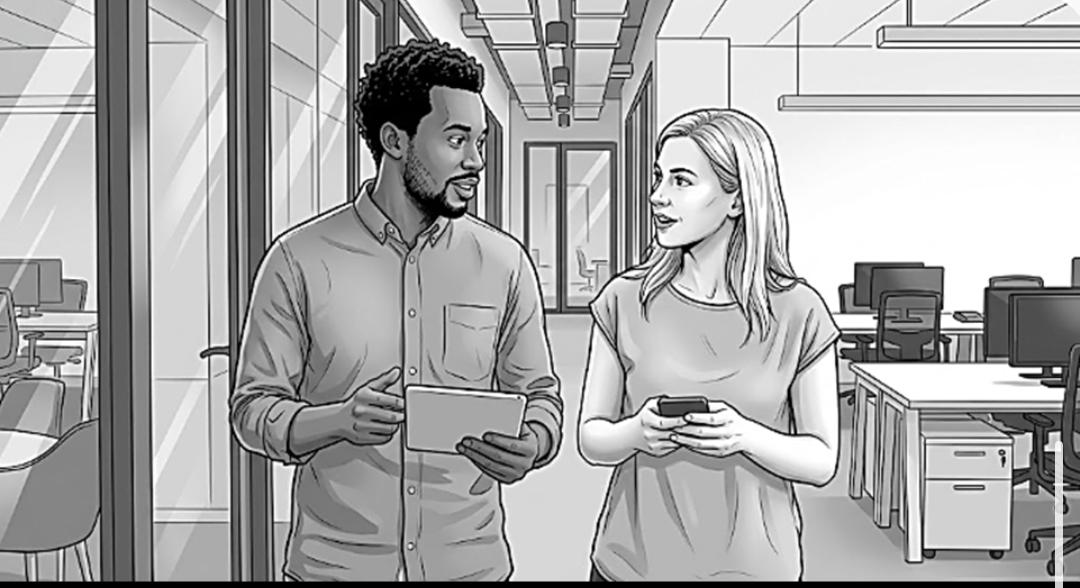
- Personas: A man and a woman in an office.
- Hombre: Short, curly, dark hair and a beard; wearing a shirt (camisa); holding a tablet.
- Mujer: Long, straight hair; wearing a T-shirt (camiseta); holding a smartphone.
- Fondo: Desks, chairs, computers, windows and ceiling lights. Looking at each other.
- Regla de oro: Como es blanco y negro, no inventes colores de ropa ni ojos que no se puedan comprobar.
«In this picture, I can see a man and a woman. They are in an office. The man has short, curly hair and a beard. He is wearing a shirt. The woman has long, straight hair. She is wearing a T-shirt. He is holding a tablet, and she is holding a smartphone. There are desks, chairs and computers behind them. They are looking at each other. I think they are talking about work. The office looks bright and clean.»
Cronómetro guiado de 5 minutos para hablar con calma
El aviso menciona 5 minutos. No te sientas obligado a hablar 5 minutos sin parar. Usa estos 5 bloques de 1 minuto para conversar paso a paso con una persona adulta:
Practice — Guía de práctica (1 al 40)
Completa cada ejercicio. Dispones de botones para comprobar respuestas, ver pistas pedagógicas y reiniciar.
Abarca ejercicios 1–25 y 33–36. Las preguntas de lectura (26–32) y producción (37–40) son de autoevaluación guiada.
Grupo A: Vocabulary (Ejercicios 1 al 8)
Grupo B: Comparatives (Ejercicios 9 al 18)
Escribe solo la forma comparativa del adjetivo (no toda la oración).
Grupo C: Future plans (Ejercicios 19 al 25)
Ejercicios 19–23: Pulsa las fichas de palabras en orden para formar la oración o escríbela directamente. No olvides la mayúscula inicial ni el punto final.
Grupo D: Reading questions (Ejercicios 26 al 32)
Responde en inglés con una oración corta basada en la lectura escolar. Como son preguntas abiertas, pulsa «Comparar con modelo» para contrastar tu respuesta con la evidencia textual literal.
Grupo E: Spot and fix the mistake (Ejercicios 33 al 36)
Encuentra el error gramatical y escribe la oración corregida (o la parte corregida).
Grupo F: Transfer and production (Ejercicios 37 al 40)
Actividades abiertas de producción libre para revisar con una persona adulta mediante la lista de verificación:
Ejemplo orientativo: «A giraffe is taller than a dog.»
Ejemplos: «I am going to read a book tomorrow.» / «I am visiting my grandmother on Sunday.»
Puedes usar el área de escritura de la Sección 5 para redactar y medir las palabras.
Mira la imagen de la Sección 6 e intenta hablar sin leer el texto modelo.
Audio y Cuadernillo Imprimible
Pistas sonoras preparadas para la práctica auditiva familiar y descarga del cuadernillo.
Reproduce las grabaciones de apoyo para cada sección. Cada reproductor incluye su transcripción textual exacta correspondiente a los apartados del temario. No tienen reproducción automática.
Ver transcripción de audio
Bigger. Smaller. Faster. Slower. Taller. Shorter. Glasses. Curly hair. Wavy hair. Blond hair. The elephant is bigger than the cat. The cat is smaller than the elephant. A rabbit is faster than a snail. A snail is slower than a rabbit. Ana is taller than Tom. Tom is shorter than Ana. He wears glasses. She has curly hair. He has wavy hair. She has blond hair.
Ver transcripción de audio
Structure A: I am going to study tomorrow. She is going to visit London next month. They are going to buy a car. Structure B: They are studying for the exam on Saturday. She is going to London next month. He is buying a new car next week.
Ver transcripción de audio
Have you ever wondered why your eyes look the way they do? In science, the features you get from your family are called inherited traits. Your eye color, shape, and vision are traits passed down from your biological parents through tiny genetic instructions. When you were born, you received a mix of traits from both your mother and your father. That is why your eye color might match one parent, or why your eyes look like a blend of both! Even if you have brothers or sisters, you won't get the exact same mix of traits, which is why your eyes are uniquely yours.
Ver transcripción de audio
In this picture, I can see a man and a woman. They are in an office. The man has short, curly hair and a beard. He is wearing a shirt. The woman has long, straight hair. She is wearing a T-shirt. He is holding a tablet, and she is holding a smartphone. There are desks, chairs and computers behind them. They are looking at each other. I think they are talking about work. The office looks bright and clean.
Ver transcripción de audio
Last Saturday, I went to the park with my family. We played football and had a picnic under a big tree. My brother brought a red ball. I ate a cheese sandwich and drank water. We laughed a lot. I felt very happy because we spent a wonderful day together.
Puedes abrir la versión diseñada para imprimir en formato cuadernillo A4 (exactamente 10 páginas limpias sin menús web ni botones) o descargar el archivo PDF:
Notas para la familia (Criterios y observaciones pedagógicas)
Fuente de estudio: Las actividades, textos y claves de esta plataforma se derivan del aviso familiar «Prueba intertrimestral–Inglés» proporcionado por el colegio.
Sin requisitos técnicos innecesarios: No se inventa acceso a plataformas externas de pago, National Geographic ni registros obligatorios. El aviso escolar menciona «viernes 30 de octubre» sin indicar año.
Acompañamiento en producción: La producción oral y escrita requiere escucha y retroalimentación afectuosa de una persona adulta. Los aciertos en los cuestionarios de opción múltiple o el conteo de palabras del diario no garantizan por sí solos el dominio del idioma; sirven como herramientas de práctica y confianza.
Privacidad garantizada: Ningún dato del estudiante ni sus escritos son registrados o enviados a través de internet.